


Prepared from public records. Not an appraisal. What is an unequal appraisal? It is a county-records comparison: similar homes assessed lower than yours. Your property is assessed at a higher percentage of its market value than similar homes in your area. You file. HouseMaxxing researches the records, and the protest is yours to submit.
Your home’s appraised value might be accurate. You can still pay more than your fair share if the county taxes neighboring properties at lower rates. That gap gives you a legal basis to challenge your assessment under Texas Tax Code 42.26, even when you can’t dispute the market value.
This guide covers the legal framework behind unequal appraisal claims and how to find comparable properties. You’ll learn how to calculate appraisal ratios and what evidence to gather.
You’ll also learn when this strategy beats a market value protest and how to file with the appraisal review board.
What Is an Unequal Appraisal? Legal Definition and Framework
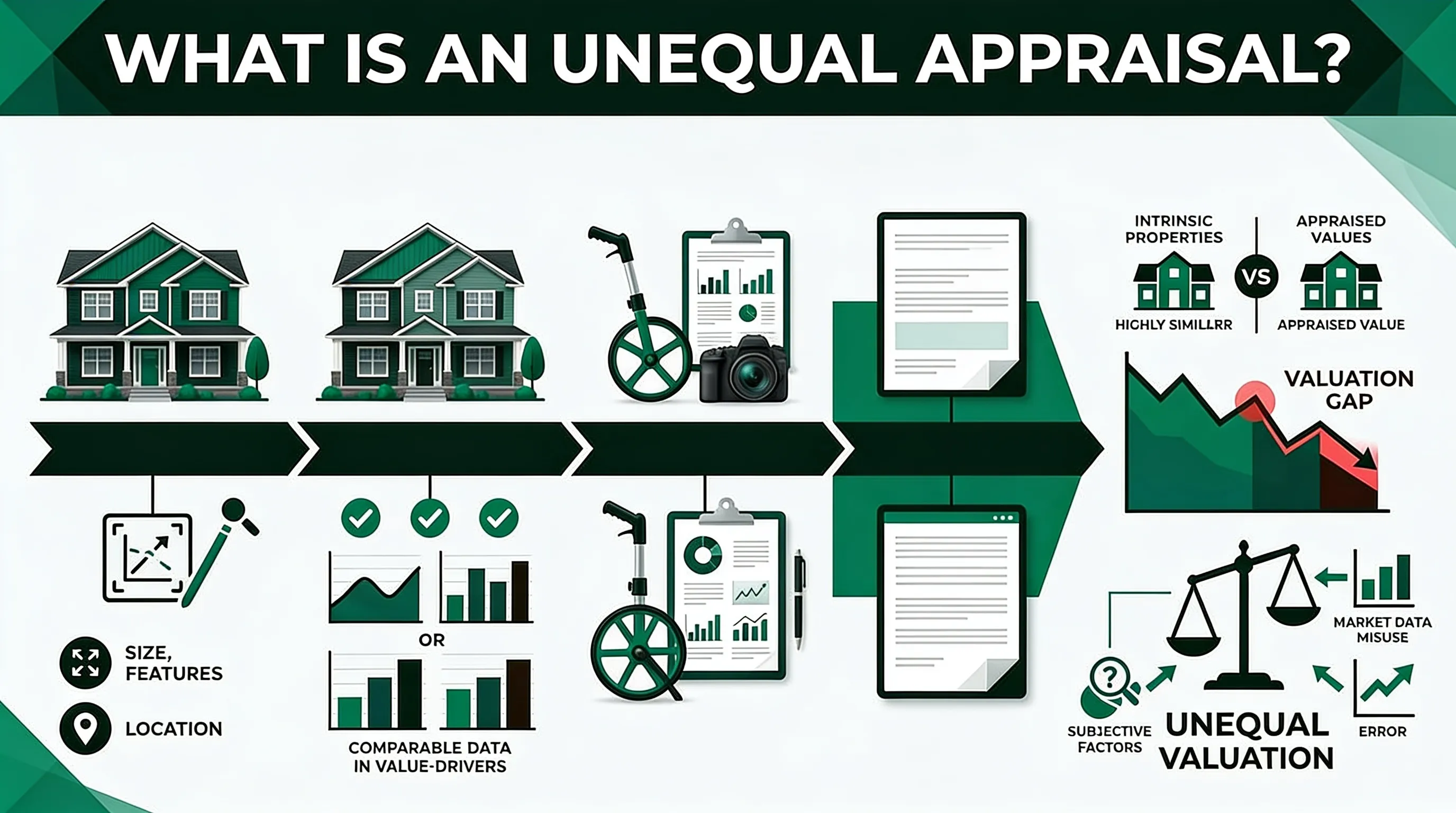
An unequal appraisal happens when the county assesses your property at a higher percentage of market value than similar properties in your district.
That gap in ratios creates grounds for a protest, even when your market value is accurate.
Texas Tax Code Section 42.26 Explained
Under Texas Tax Code Section 42.26, property owners can challenge assessments based on inequality, not just incorrect market value. The statute lets you show that the county appraised your property at a higher ratio than the median for comparable properties.
The law shifts the focus from absolute values to relative assessment levels. You don’t need to prove your home is worth less than the district says. Instead, you show that the county treated similar properties better.
How Unequal Appraisal Differs from Market Value Appeals
A market value appeal argues that your property’s assessed value exceeds its actual worth. You present evidence like recent sales data, appraisals, or property condition issues to support a lower valuation.

An unequal appraisal takes a different approach. You accept that your property might be worth what the district says.
Then you show that the county assessed comparable properties at lower percentages of their market values. This works well when your value is correct but your ratio is too high.
The Median Appraisal Ratio Standard
To find the median appraisal ratio, divide each property’s assessed value by its market value. Courts expect you to do this for several comparable properties and pick the middle value.
If your ratio beats the median by a material amount, you have grounds for a reduction. Texas courts often treat a 10% difference as material, though the threshold can vary by case. You need sales data and assessment records that show the gap.
Unequal Appraisal vs. Your County Notice in Plain Language
Each spring, your county appraisal district mails a notice of appraised value. It lists the value the county assigned to your property and the amount it plans to use for your tax bill.
The notice tells you what the county decided about your home. It does not tell you how that decision compares with the homes around you.
An unequal appraisal answers that second question. You line up similar homes using public records and check how the county valued each one. If your home sits higher than the middle of that group, the county treated your home less favorably than similar ones.
Think of the notice as one line on a receipt. An unequal appraisal reads the receipts of nearby homes to see whether everyone was charged at the same rate. Neither is an opinion about what your home would sell for. Both come from the county’s own certified numbers.
When to Use an Unequal Appraisal Strategy
The right choice between an unequal appraisal and a market value protest depends on your situation. An unequal appraisal works best when your assessed value matches your market value. Your ratio, though, is too high compared to similar homes.
Market Value vs. Unequal Appraisal: Choosing Your Approach
If recent sales data shows your home is overvalued, pursue a market value protest. This approach challenges the absolute dollar amount of your assessment.
Suppose comparable sales support your current value, but similar homes have lower ratios. Then an unequal appraisal is the stronger strategy. You’re not arguing that your home is worth less. You’re showing that the district assessed it at a higher percentage of market value than nearby homes.
Texas law lets you make both arguments at once. You file the protest yourself. HouseMaxxing public-records research reports the county’s certified numbers. You then decide which argument fits your situation.
Scenarios Where Unequal Appraisal Works Best
This strategy fits rising markets, where appraisal districts lag in updating every property.
Properties in neighborhoods with inconsistent assessment practices benefit most from this approach. If your home was reassessed recently while older assessments remain on similar properties, the ratio disparity creates clear grounds for protest.
Consider this strategy when you find three or more comparable properties with ratios at least 10% lower than yours. Your case gets stronger when the median ratio sits well below your ratio. This holds true even if the county assessed all homes near their market values.
Identifying Comparable Properties for Your Appeal
Finding the right properties to compare against yours is the first step of a successful protest. You need at least three comparable properties to establish a valid median ratio under Texas law.
Geographic and Physical Similarity Requirements
Comparable properties must be located in the same neighborhood or area with similar market conditions. The closer they are to your property, the stronger your case becomes.
Physical characteristics should match closely. Focus on square footage within 15-20% of your home, similar age and construction quality, and comparable condition. A 2,000-square-foot home built in 2026 won’t work as a comparison for a 4,000-square-foot home built in 1985.
Skip properties with unique features. Examples include pools, big remodels from the past year, or special use codes. These factors skew appraisal ratios and weaken your argument.
Properties with recent sales data work best because they provide verifiable market values. This allows you to calculate accurate appraisal-to-market-value ratios for your comparison.
Accessing Appraisal District Data
Appraisal district records are public information. Most Texas counties provide online access through their websites where you can search by address, owner name, or property ID.
For in-person requests, visit your county appraisal district office during business hours. Staff can help you pull records for specific properties. Pulling records for 10-15 potential comparables gives you enough options to select the strongest three to five properties for your protest.
Calculating Appraisal Ratios: A Step-by-Step Example
The math behind appraisal ratios helps you build a solid case. It takes care, but the formula is simple.
The Mathematical Formula
The appraisal ratio equals your property’s assessed value divided by its actual market value, expressed as a percentage. You calculate it by taking the assessed value, dividing by the market value, then multiplying by 100.
Evidence Requirements for Proving Unequal Appraisal
Start by gathering certified appraisal district records that show assessed values for your property and all comparables. These records are public and available through your county appraisal district website or office.
Obtain recent sales data from MLS listings, deed records, or professional appraisal reports. You need actual sale prices to calculate accurate appraisal ratios for each comparable property.
Create a comparison chart showing property addresses, assessed values, sale prices, and calculated ratios. This chart becomes your primary evidence, so organize it clearly with columns that appraisal review boards can scan quickly.
Common Mistakes That Weaken Your Case
Avoid using properties that sold under distress conditions, between family members, or in non-arm’s-length transactions. These sales don’t reflect true market values and will undermine your ratio calculations.
Don’t include comparables with major differences in square footage, age, or condition. A 2,000-square-foot home built in 2026 won’t support an appeal for a 3,500-square-foot home from 1985.
Never submit messy evidence or handwritten notes. Review boards hear hundreds of cases. They will dismiss data that is hard to read, even when your math is sound.
The Unequal Appraisal Appeal Process in Texas
Filing Deadlines and Required Forms
You must file your protest by May 15 or within 30 days of receiving your appraisal notice, whichever comes later. If you miss this deadline, you lose your right to challenge your assessment for that tax year.
Fill out the official protest form from your county appraisal district. Most districts offer online filing. You can also submit a paper form in person or by mail.
State on your form that you are protesting for unequal appraisal under Texas Tax Code Section 42.26. This tells the board your challenge is about the gap in assessments, not market value. You can check both boxes if you want to argue both grounds.
Attach an evidence package that shows the appraisal ratios for comparable properties. Include your calculations, property data, and any records that show the gap.
What Happens at Your Hearing
The appraisal review board will schedule your hearing between June and August. You’ll receive notice of the date, time, and location at least 15 days in advance.
Present your evidence clearly at the hearing. Focus on the statistical disparity in appraisal ratios rather than arguing about your property’s market value. Show the board your comparison chart with calculated ratios for each comparable property.
The board may reduce your assessed value to match the median ratio of comparable properties if your evidence proves the inequality. They will issue a written determination within a few days of your hearing.
If the board denies your protest, you have two appeal options. You can file in district court within 60 days of receiving the order, or you can request binding arbitration within 60 days. Arbitration costs around $500 but provides a faster resolution than court proceedings.
Conclusion
So, what is an unequal appraisal? It is proof that your assessment ratio is higher than the median ratio of comparable homes. You don’t need to show that your market value is wrong. That makes it an effective protest option for Texas homeowners.
Start by gathering appraisal records and recent sales data for at least five comparable properties in your neighborhood. Calculate each property’s appraisal ratio by dividing its assessed value by its sale price. If your ratio exceeds the median by 10% or more, you have a strong case. File your protest by May 15 or within 30 days of receiving your notice, and prepare clear documentation showing the statistical disparity.
Prepared from public records. Not an appraisal.
If you think similar homes nearby are assessed lower than yours, start with HouseMaxxing to see the county’s certified numbers for your street. You receive a public-records research report, and you decide whether to file. You file.







 Ask ChatGPT
 Ask Claude
 Ask Perplexity