


The New York STAR exemption lowers your property tax bill. It cuts your main home’s taxable value before school taxes come into play.
New York homeowners pay some of the highest property taxes in the country. The average effective rate is 1.62%, and the typical homeowner pays about $6,800 a year. The School Tax Relief program offers direct savings. Many eligible homeowners leave hundreds or even thousands of dollars on the table. They don’t know how the program works or which version they qualify for.
This guide walks you through both Basic and Enhanced STAR options. It shows you the eligibility rules and income limits for 2027. You’ll learn how to apply, one step at a time.
You’ll see how much you could save based on your school district’s tax rate. You’ll also pick up tips to avoid common application mistakes. Finally, you’ll find out whether the exemption or the credit is the better fit for you.
What Is the New York STAR Exemption?
The New York STAR exemption lowers your property taxes. It cuts the assessed value of your home before school taxes apply.
Eligible homeowners can save hundreds to thousands of dollars a year on their school tax bills. It works much like a homestead exemption, which many states use to cut taxes on a primary residence.
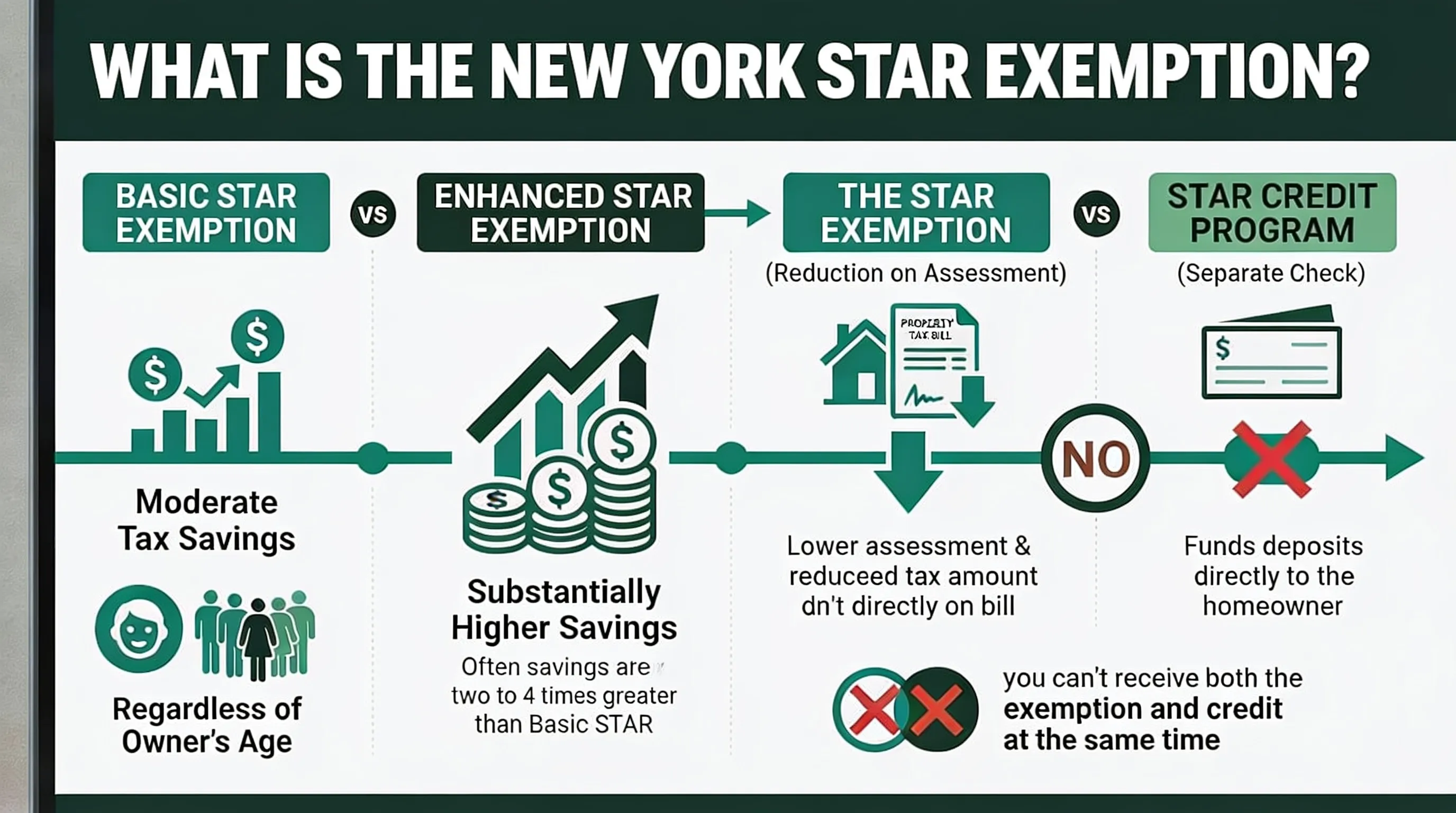
According to the New York State Tax Department, the program offers two tiers based on age and income, each providing different levels of relief.
Basic STAR vs Enhanced STAR
Basic STAR is available to homeowners under age 65 whose household income falls below $500,000. This tier provides moderate tax savings regardless of the owner’s age.
Enhanced STAR serves homeowners 65 or older with household incomes at or below $113,550. This tier delivers substantially higher savings, often two to four times what Basic STAR provides.
How STAR Reduces Your Tax Bill
The exemption takes a chunk off your home’s assessed value before school districts figure out your tax bill. Say your home is assessed at $300,000 and STAR knocks off $50,000. Then you only pay school taxes on $250,000.

This differs from the STAR credit program, which sends a separate check instead of reducing your assessment. You can’t receive both the exemption and credit at the same time.
STAR Exemption Eligibility Requirements
You must meet specific criteria to qualify for the New York STAR exemption. The rules differ slightly between Basic and Enhanced STAR, but both programs require strict compliance with residence and income thresholds.
Primary Residence Requirement
The property must be your primary residence and owner-occupied. You can only claim the exemption on one home, even if you own multiple properties.
Co-ops and condominiums qualify if you meet the residence requirements. All owners and their resident spouses must live at the property as their main home.
According to the New York STAR registration portal, you’ll need to provide proof of ownership and Social Security numbers when registering. Many homeowners working with HouseMaxxing find that gathering these documents before starting the application speeds up the process.
Income Limits for 2027
Basic STAR requires a combined income of $500,000 or less for 2027. This limit applies to all property owners and their resident spouses.
Enhanced STAR has a much lower threshold: $113,550 or less for 2027. This amount adjusts annually based on inflation. At least one owner must be 65 or older by December 31 of the tax year to qualify for Enhanced STAR.
Income calculations include all owners and resident spouses, regardless of whether they appear on the deed. The state uses your federal adjusted gross income from two years prior, so your 2027 exemption depends on your 2025 tax return.
How to Apply for the STAR Exemption
New homeowners must register through the New York State Tax Department online portal to receive the exemption. You’ll need proof of ownership, Social Security numbers for all owners, and income verification documents.
New Homeowner Application Process
The application deadline is typically March 1 for the exemption to appear on your current tax year bill. Submit your registration as soon as you close on your property to avoid missing this deadline.
Processing usually takes 4-6 weeks. The exemption will appear as a reduced assessed value on your school tax bill, not as a separate line item. At HouseMaxxing, we recommend checking your bill carefully to confirm the reduction was applied.
Automatic Renewal and When to Reapply
Existing recipients get automatic renewal each year if their income stays below the threshold. You don’t need to reapply annually.
Update your registration when you experience a change in ownership, marital status, or primary residence. Failure to report these changes can result in removal from the program and potential penalties.
Maximum STAR Savings by School District
Your STAR savings depend on your school district’s tax rate and your home’s assessed value. The exemption removes a portion of your home’s assessed value before school taxes apply.
Basic STAR typically saves homeowners $200 to $800 annually, while Enhanced STAR delivers $1,000 to $3,000 or more in high-tax areas. The actual amount reflects your district’s per-student spending and local tax structure.
High-Savings Districts in 2027
Nassau and Westchester counties offer the highest dollar savings due to elevated property values and school tax rates. Districts like Great Neck and Scarsdale frequently see Enhanced STAR recipients save over $2,500 per year.
Rural districts often provide lower absolute savings but can reduce your school tax bill by a higher percentage. A $400 savings in a rural area might represent 20% of your total school taxes, while $1,500 in a suburban district could be just 15%.
You can find your specific district’s exemption amount through the New York State Tax Department’s online lookup tool.
Enter your county and school district to see current exemption values and calculate your expected savings based on your home’s assessed value.
STAR Exemption vs STAR Credit: Which Is Better?
New York offers two ways to receive STAR benefits, and the differences affect how you get your savings.
Main Differences Between Programs
The STAR exemption reduces your home’s assessed value before school taxes are calculated, lowering your bill directly. The STAR credit sends you a separate check after you’ve paid your full property tax bill.

If you applied for STAR before 2027, you received the exemption automatically. Anyone applying since 2016 gets enrolled in the credit program instead.
You cannot receive both benefits at once. The credit often equals or exceeds exemption savings in most districts because it’s calculated based on actual tax rates rather than assessed values.
Switching Between Exemption and Credit
Homeowners who received the exemption before 2016 can keep it or switch to the credit program. Once you switch to the credit, you cannot return to the exemption.
To decide which saves you more, compare your current exemption amount (shown on your tax bill) against the credit amount for your district. The New York State Tax Department website provides credit estimates by school district and income level.
Most homeowners find the credit more convenient since it arrives as a direct payment, though some prefer seeing the reduction on their bill upfront.
Common STAR Exemption Mistakes to Avoid
Many homeowners lose thousands in property tax savings by making preventable errors with their STAR registration. The most frequent mistake is failing to register when purchasing a new home, assuming the exemption transfers automatically from the previous owner.
Another costly error involves claiming STAR on multiple properties. You can only receive the exemption on one primary residence, and claiming it elsewhere triggers penalties and back taxes.
Life changes require immediate action. Not updating your registration after marriage, divorce, or inheriting a property can result in automatic removal from the program.
Key Considerations
Income reporting deadlines matter greatly. Missing the deadline to report income changes triggers automatic removal, even if you still qualify based on earnings.
Many homeowners assume automatic eligibility without checking current income limits. The Basic STAR threshold of $500,000 seems high, but combined household income can exceed this faster than expected.
Overlooking Enhanced STAR when turning 65 leaves substantial savings unclaimed. You must actively apply for the upgrade, as it doesn’t happen automatically.
To correct errors and reinstate your exemption after removal, contact your local assessor’s office immediately. You’ll need to resubmit documentation and may face a waiting period before savings resume.
Combining STAR with Other Property Tax Exemptions
You can stack STAR with most other property tax exemptions to maximize your savings. STAR reduces your home’s assessed value for school tax purposes, while other exemptions reduce different portions of your tax bill.
Veterans exemptions work alongside STAR in most municipalities. If you qualify for both, you’ll receive separate reductions on your property tax bill.
Enhanced STAR pairs with the senior citizens exemption under Section 467. These programs target different tax components, so qualifying seniors can benefit from both simultaneously.
Disability exemptions remain compatible with both Basic and Enhanced STAR. The disability reduction applies to your general tax bill, while STAR specifically lowers school taxes.
Key Considerations
Agricultural exemptions don’t interfere with STAR eligibility. Farmers who use their property as their primary residence can claim both benefits without conflict.
Check your local municipality for additional exemptions beyond state programs. Some counties offer extra relief for firefighters, clergy, or low-income homeowners that stack with STAR.
Each exemption reduces a specific tax component, so multiple exemptions compound your total savings rather than overlap. Calculate your combined benefit by reviewing how each program affects different portions of your annual tax bill.
What to Do If Your STAR Application Is Denied
The New York State Tax Department denies STAR applications for several clear reasons. Your income may exceed the $500,000 limit for Basic STAR or the $113,550 threshold for Enhanced STAR.
The property might not qualify as your primary residence, or you submitted incomplete documentation. Missing Social Security numbers or income verification documents trigger automatic denials.
Key Considerations
You can request a written explanation of your denial from the Tax Department within 30 days. This letter details the specific reason and provides guidance for next steps.
The appeal process requires filing a formal challenge within 30 days of the denial notice. You’ll submit supporting documents that address the denial reason, such as corrected income statements or proof of primary residence.
Resubmit your application if the denial resulted from fixable errors like missing paperwork. The Tax Department allows corrections for documentation issues without waiting for the next tax year.
Seek professional help when dealing with complex income calculations involving trusts, business ownership, or multiple properties. Tax professionals understand how different income sources affect eligibility thresholds.
If you don’t qualify for the new york star exemption, explore alternative relief programs. The Senior Citizens Exemption or veterans benefits may provide comparable savings depending on your circumstances.
Conclusion
The New York STAR exemption offers real savings on your school property taxes.
You can qualify for either the Basic program or the Enhanced version for seniors. The difference between paying full school taxes and receiving this benefit can add up. You could save hundreds or thousands of dollars each year. The amount depends on where you live and which tier you’re eligible for.
If you haven’t applied yet, register through the New York State Tax Department’s online portal before the March 1 deadline. Current recipients should verify their income still falls below the threshold. Update your registration if you’ve experienced any life changes. These include marriage, divorce, or turning 65. Review your tax bill each year to confirm the exemption appears correctly.
Beyond STAR, your property assessment itself may be costing you more than necessary. Start with a free check on HouseMaxxing. We analyze your assessment and file an appeal in under 60 seconds, and you pay only if we successfully lower your taxes.







 Ask ChatGPT
 Ask Claude
 Ask Perplexity