


The Georgia homestead exemption can save you hundreds or even thousands of dollars on your annual property tax bill, but you need to apply to get it. Many homeowners miss out on these savings because they don’t know which exemptions they qualify for or how the application process works. Georgia offers several types of exemptions, including standard homestead protection, age-based reductions, and disability benefits that can stack together for greater savings.
This guide walks you through every Georgia homestead exemption type, explains who qualifies for each one, and shows you precisely how to apply. You’ll learn where to find your county’s application forms, what documents you need, when to file, and how to avoid the common mistakes that cause denials.
What Is the Georgia Homestead Exemption?
A homestead exemption reduces the assessed value of your primary residence for property tax purposes. This reduction lowers the amount of property taxes you owe each year by exempting a portion of your home’s value from taxation.
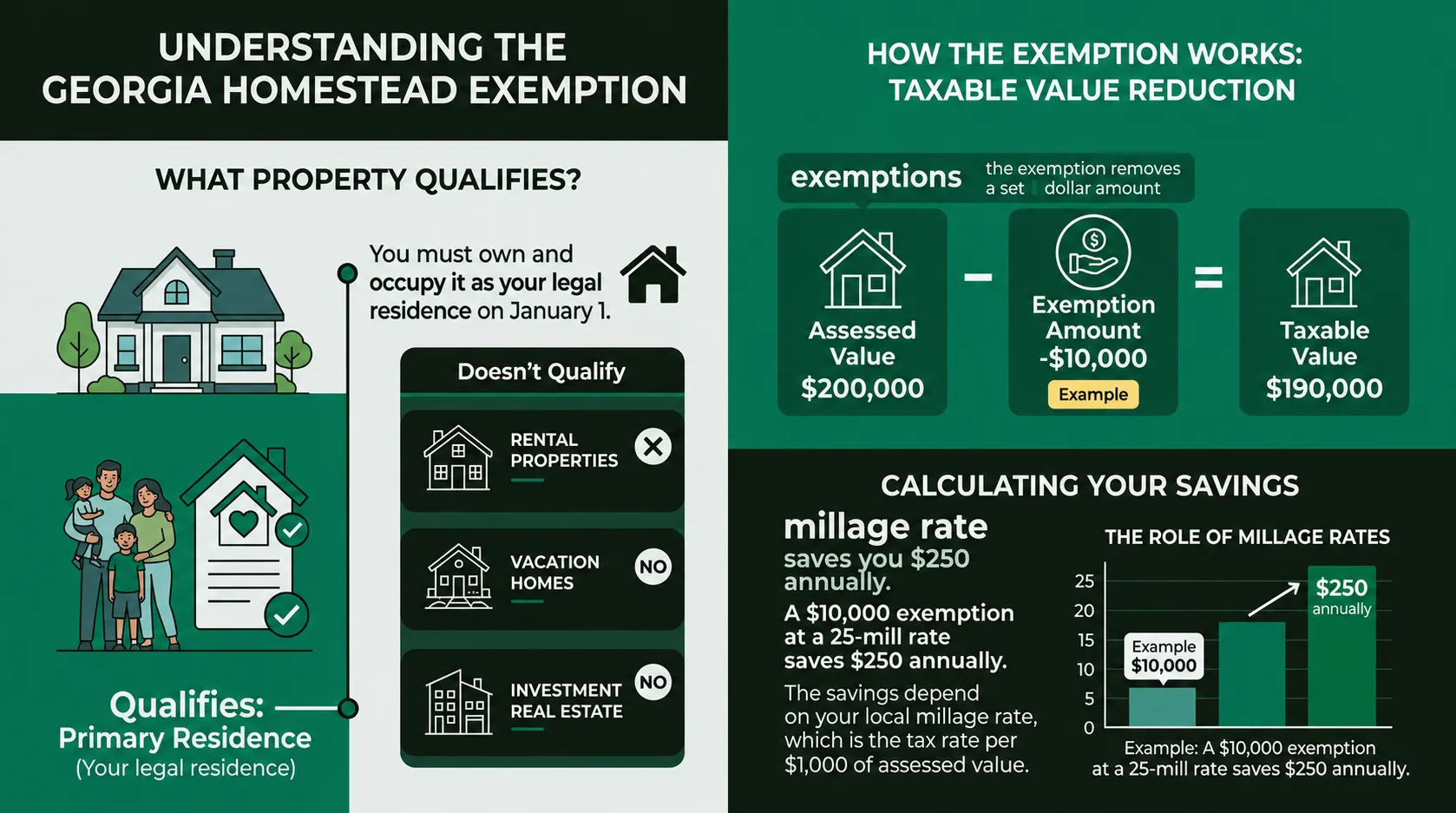
The exemption applies only to your main home where you live full-time. You can’t claim it for rental properties, vacation homes, or investment real estate.
How Property Tax Exemptions Work in Georgia
The exemption removes a set dollar amount from your home’s assessed value before calculating your tax bill. For example, if your home is assessed at $200,000 and you receive a $10,000 exemption, you only pay taxes on $190,000.
The savings depend on your local millage rate, which is the tax rate per $1,000 of assessed value. A $10,000 exemption with a 25-mill rate saves you $250 annually.
State vs. County Exemption Programs
Georgia’s exemption system operates through multiple government layers. The state mandates certain exemptions that apply statewide, while individual counties offer additional programs specific to their area.
State exemptions provide a baseline level of tax relief available to all qualifying Georgia homeowners. Counties can add their own exemptions on top of state programs, creating variation in total savings based on where you live.
Some counties offer enhanced exemptions for seniors, disabled homeowners, or veterans that go beyond state requirements. This means two homeowners with identical situations may receive different exemption amounts depending on their county’s local programs.
Types of Homestead Exemptions Available in Georgia
Georgia offers several exemption types that reduce your property tax bill. You can combine multiple exemptions when you meet the requirements for more than one.
Standard Homestead Exemption
Georgia’s standard homestead exemption is $2,000. It is deducted from the 40% assessed value of the home and applies to county and school taxes, subject to state law.
Georgia also offers a floating inflation-proof exemption for qualifying homeowners age 62 and older. Income limits apply, and the exemption is generally used in place of another county homestead exemption.
Senior Citizen Exemptions
Homeowners age 62 and older may qualify for additional exemptions if they meet the applicable age, income, and other requirements. Some counties set thresholds at $10,000, while others go up to $30,000 or higher. Income limits depend on the specific exemption and county.
Many homeowners at HouseMaxxing discover they qualify for senior exemptions they didn’t know existed. Check your county’s specific income threshold, as it affects how much you can save.
Disability and Veteran Exemptions
Some disability-based exemptions are available to qualifying homeowners who meet the program’s age, disability, income, and other requirements. According to the Georgia Department of Revenue, qualifying disabled veterans may receive a homestead exemption from state, county, municipal, and school property taxes.
The disability exemption requires documentation from the Social Security Administration or Veterans Affairs. Veterans need proof of their service-connected disability rating.
School Tax Exemptions
School tax exemptions have specific income requirements separate from other exemptions. Most counties set the threshold between $10,000 and $15,000 in adjusted gross income. The requirements vary by exemption and county.
This exemption removes school taxes from your bill entirely when you meet both age and income requirements. You must reapply annually to verify your income stays below the limit.
Georgia Homestead Exemption Eligibility Requirements
Meeting the eligibility criteria for a Georgia homestead exemption requires careful attention to specific rules. You must own and occupy the property as your primary residence by January 1 of the tax year you’re applying for. This date serves as the cutoff for establishing your eligibility.
Primary Residence Requirement
Your home must be your legal primary residence where you live most of the year. According to Georgia.gov, you must own the property on January 1, occupy it, and use it as your legal residence. Acceptable proof includes your Georgia driver’s license, voter registration, vehicle registration, and tax returns showing the property address.
Renting out part of your home or using it for business can affect your exemption. Minor business use like a home office usually doesn’t disqualify you, but converting substantial portions to rental or commercial space may reduce or eliminate your exemption.
Ownership and Occupancy Rules
Partial ownership situations require special consideration. When multiple people own a property, only the owner who occupies it as a primary residence qualifies for the exemption.
Surviving spouses receive special treatment. They can continue receiving the exemption after a spouse’s death, even if the property title changes, provided they maintain it as their primary residence. Many homeowners work with HouseMaxxing to understand how these ownership rules apply to their specific situations.
Income Limitations for Enhanced Exemptions
Standard exemptions have no income limits. However, age-based and disability exemptions often include income thresholds that vary by county.
Senior exemptions for residents 62 and older typically require household income below county-set limits. These thresholds differ across Georgia’s 159 counties, so check with your local tax assessor for specific amounts. Disability exemptions may have similar income requirements depending on the exemption type and county.
Understanding Homestead Exemption Amounts and How They Work
Homestead exemptions reduce your property tax bill by lowering the assessed value used to calculate what you owe. The exemption amount gets subtracted from your home’s assessed value before the county applies its millage rate.

For example, if your home has a $250,000 assessed value and you qualify for a $50,000 exemption, you would calculate the taxable value using $200,000. The county then multiplies this reduced amount by the millage rate to determine your tax bill.
How Exemption Amounts Are Applied
Your county tax assessor calculates property taxes in three steps. First, they determine your home’s assessed value. Second, they subtract any exemptions you qualify for. Third, they multiply the result by the local millage rate.
Different exemption types apply to different portions of your property tax bill. School tax exemptions reduce the school portion, while county exemptions affect county taxes.
When property values rise, exemptions protect you from the full increase. If your home’s value jumps from $200,000 to $250,000, a $50,000 exemption means you only pay taxes on the $50,000 increase minus any floating exemption adjustments.
County-by-County Exemption Examples
Fulton County offers a $30,000 standard exemption plus additional school tax exemptions. Gwinnett County provides similar amounts but structures them differently across school and county taxes.
Cobb County residents can access up to $40,000 in combined exemptions when qualifying for multiple programs. DeKalb County offers age-based exemptions starting at $10,000 for residents 62 and older, with higher amounts for those meeting income limits.
Combining Multiple Exemptions
You can stack exemptions when you meet requirements for more than one type. A 65-year-old homeowner might combine the standard exemption with an age-based exemption and a school tax exemption, reducing taxable value by $70,000 or more. The amount and combination depend on the specific programs and county rules.
Each exemption type targets different portions of your tax bill. The standard exemption applies to county taxes, while school exemptions reduce only education-related levies. This layering creates substantial savings for those who qualify for multiple programs.
Where to Find Your County’s Homestead Exemption Application Form
Start by visiting your county tax assessor’s website. Search for your county name plus “tax assessor” to find the official site. Most assessor websites list exemption forms under sections labeled “Property Tax,” “Exemptions,” or “Homestead.”
County Tax Assessor Websites and Offices
Fulton County posts homestead exemption information and applications on its Board of Assessors website. Cobb County organizes exemption details by type, and according to the Cobb County Tax Commissioner, you can download specific forms for standard, senior, and disability exemptions. For other counties, use the Georgia Department of Revenue’s County Property Tax Facts page to find your local tax office.
Online Application Portals by County
Some counties offer online filing through their websites. Fulton and Gwinnett provide digital submission options for certain exemptions. Most counties still require paper forms submitted by mail or in person.
Check your county’s site to see which method applies.
Alternative Ways to Obtain Forms
Call your county tax assessor’s office to request forms by mail. Staff can mail applications to your address within a few business days.
Visit the assessor’s office in person to pick up forms immediately. Bring identification to verify your property ownership.
If your county’s website is hard to navigate, use the Georgia Department of Revenue’s County Property Tax Facts page to find your local tax office.
How to Apply for Georgia Homestead Exemption
Application Timeline and Deadlines
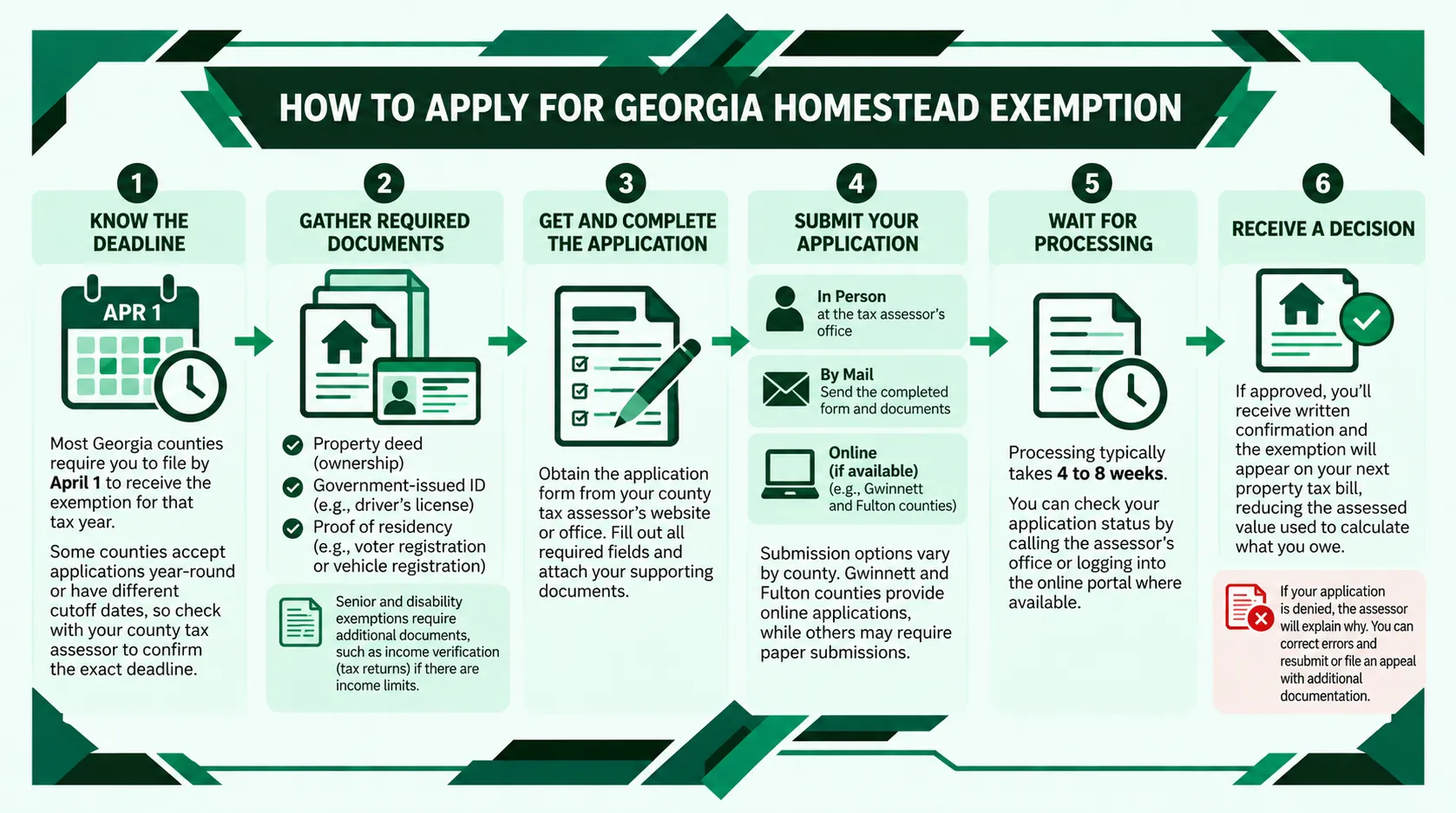
Most Georgia counties require you to file by April 1 to receive the exemption for that tax year. Missing this deadline means you’ll wait until the following year to get any tax relief.
Some counties accept applications year-round or use different cutoff dates. Contact your county tax assessor to confirm the exact deadline, since local rules vary.
Required Documents and Forms
You’ll need your property deed showing ownership, a government-issued ID like a driver’s license, and proof of residency such as voter registration or vehicle registration. Required documents vary by county and exemption.
Senior and disability exemptions require additional documentation. Bring income verification like tax returns if you’re applying for age-based or disability exemptions with income limits.
County Tax Assessor Application Process
Start by obtaining the application form from your county tax assessor’s website or office. Fill out all required fields and attach your supporting documents.
You can submit in person at the tax assessor’s office, mail the completed form, or use the online portal if your county offers one. Gwinnett and Fulton counties provide online applications, while others require paper submissions.
Processing typically takes four to eight weeks. You can check your application status by calling the assessor’s office or logging into the online portal where available.
After approval, you’ll receive written confirmation. The exemption appears on your next property tax bill, reducing the assessed value used to calculate what you owe.
If your application gets denied, the assessor will explain why. You can correct errors and resubmit or file an appeal with additional documentation supporting your eligibility.
Common Georgia Homestead Exemption Mistakes to Avoid
Application Errors That Cause Denials
Incomplete forms cause most application rejections. Missing a signature, leaving required fields blank, or failing to attach documentation stops your application before review begins.
Tax assessors need specific proof of residency. You must submit copies of your driver’s license, vehicle registration, and voter registration showing your property address. Without all three documents, your application gets denied.
Property deeds with name mismatches create problems. If your deed shows a different name than your ID, you’ll need legal documentation explaining the discrepancy before approval.
Missing Deadlines and Renewal Requirements
Most Georgia counties enforce an April 1 deadline each year. Missing this date means waiting until the following year to apply, costing you a full year of tax savings.
Your exemption typically renews automatically once approved. You don’t need to reapply annually unless you move or your county requires updated documentation for age-based or income-restricted exemptions.
Reporting Changes in Circumstances
You must notify your county tax assessor when you sell, move out, or rent your property. These changes disqualify you from the exemption immediately.
Converting part of your home to business use or renting out rooms can affect eligibility. Contact your assessor to determine if partial business use disqualifies your entire exemption.
Fraudulent claims carry serious penalties. Failing to report disqualifying changes can result in back taxes, interest charges, and potential legal action.
If your application gets denied, you can appeal within 30 days. Gather additional documentation proving residency and occupancy to strengthen your case during the appeal process.
County-Specific Homestead Exemption Rules in Georgia
Georgia’s 159 counties set their own exemption amounts within state guidelines. This means your tax savings depend heavily on where you live.
Major Metro Atlanta Counties
Homestead exemption amounts vary by county and taxing jurisdiction. The following examples show how five major Georgia counties structure their regular or basic homestead exemptions.
| County | County Exemption | School Exemption | Georgia Basic Exemption |
|---|---|---|---|
| Fulton | $30,000 | $2,000* | $2,000 |
| DeKalb | $10,000 | $12,500 | $2,000 |
| Gwinnett | $10,000 | $8,000 | $2,000 |
| Cobb | $10,000 | $10,000 | $2,000 |
| Clayton | $10,000 | Not separately stated | $2,000 |
Note: Homestead exemption amounts can differ by taxing jurisdiction and by the exemption claimed. Fulton County also has additional local exemptions, including a $30,000 exemption for qualifying Atlanta residents. The statewide $2,000 basic homestead exemption is applied to county and school taxes and does not add on top of a larger local exemption.
Rural and Smaller County Variations
Rural counties often provide lower exemption amounts that reflect their smaller tax bases and lower property values. Some counties offer only the state-mandated minimum.
However, several rural counties add local exemptions beyond state requirements. These additional exemptions help offset property tax burdens in areas with limited services.
How to Find Your County’s Specific Requirements
Contact your county tax assessor’s office directly for current exemption amounts. Counties may adjust these periodically through local ordinances.
Visit your county’s official website and search for the tax assessor or tax commissioner section. Most offices list exemption amounts and application requirements online.
You can also call the assessor’s office during business hours. Staff can confirm which exemptions you qualify for and provide current dollar amounts.
Conclusion
The Georgia homestead exemption reduces your property tax bill by lowering the assessed value of your primary residence. You can claim multiple exemptions if you meet the requirements for age, disability, or veteran status, and most applications need to reach your county tax assessor’s office by April 1.
Start by checking your county’s specific exemption amounts and income limits, since these vary across Georgia. Gather your property deed, government-issued ID, and proof of residency documents before you apply. Submit your application early to avoid the deadline and allow time to fix any issues the assessor identifies.
If you’ve already secured your homestead exemption but want to explore whether your property assessment is accurate, HouseMaxxing can analyze your home and file a property tax appeal in under 60 seconds. You only pay our flat fee if we win your appeal. See what may apply!







 Ask ChatGPT
 Ask Claude
 Ask Perplexity