


Your notice of appraised value is prepared from public records. It is not an appraisal, it’s the county’s official record of your property’s assessed value for tax purposes.
This value determines your property tax bill when multiplied by local tax rates. The notice contains technical terms, multiple value types, and calculations that most homeowners misinterpret. Missing an error or overassessment means you could overpay for years without realizing it. You file any protest with your county appraisal district.
This guide walks you through each section of your notice. You’ll decode the property description and learn the difference between appraised value vs market value. You’ll read the comparable sales data and spot red flags that justify an appeal.
You’ll also learn which numbers matter, how to catch common errors, and when a protest makes financial sense.
How to Read Your Notice of Appraised Value
A notice of appraised value is the county’s official record of your property’s assessed value for tax purposes. It is not an appraisal. This value determines your property tax bill for the coming year when multiplied by your local tax rates.
Understanding the Notice Fields
Your notice contains five main fields that determine your tax bill:
-
Owner Name: Your name and address as recorded by the county.
-
Legal Description: The official property identifier used by the county (lot, block, and subdivision numbers).
-
Appraised Value: The county’s estimate of your property’s market value, subject to state caps.
-
Exemptions on File: Tax breaks you qualify for (homestead, senior, disability, veteran).
-
Protest Deadline: The date by which you must file an appeal, typically 30–45 days from the notice date.
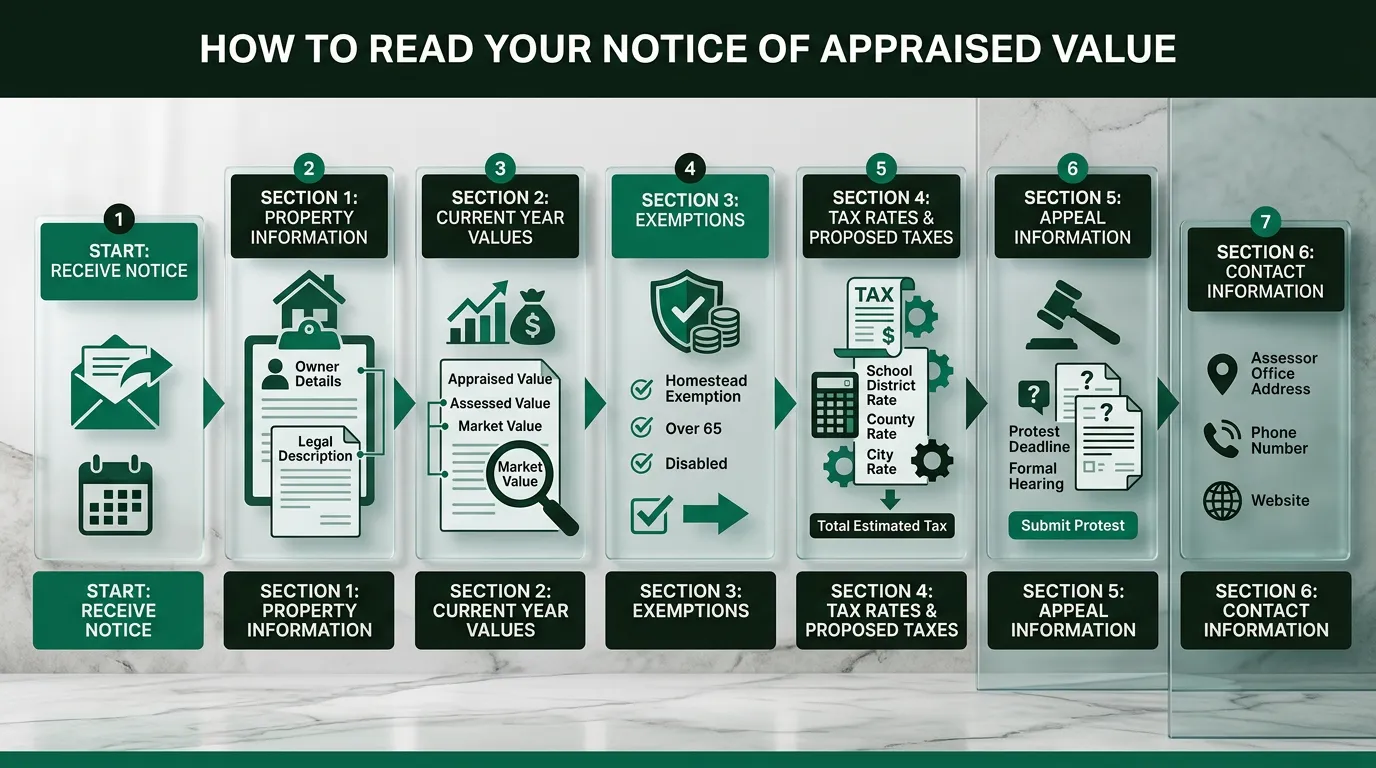
The notice serves as both an informational document and a legal notification of your rights. It shows how the appraisal district calculated your property’s value and provides details about your options if you disagree with the assessment.
What the Notice Tells You
Your notice establishes the legal basis for your property tax bill. According to the Texas Comptroller, appraisal districts must follow set methods to find property values. These include market data analysis and property characteristics.
The notice also explains your protest rights and how to challenge your assessed value. These rights expire if you don’t use them within the deadline.
Your Protest Deadline
Most counties mail notices between April and May each year. The exact timing varies by jurisdiction, but you should receive yours well before tax bills are due.

Your appeal deadline typically falls 30 to 45 days after you receive the notice. Some counties include the postmark date, while others use the date printed on the notice itself.
What Happens If You Ignore It
Ignoring your notice means accepting the assessed value as final. If your home is overvalued, you’ll overpay property taxes for the whole year.
Your protest rights expire once the deadline passes. After that, you can’t challenge the assessment, even if you find errors or comparable homes valued much lower than yours.
Understanding the Different Property Values on Your Notice
Your notice lists several values that look similar but serve different purposes. Knowing which is which helps you spot errors and decide whether to appeal.
Market Value vs. Appraised Value
Market value represents what the appraisal district believes your property would sell for on the open market. This is their estimate based on recent sales, property characteristics, and market conditions.
Appraised value may match market value. Your state’s homestead laws may also cap it at a lower amount. In Texas, homestead properties benefit from a 10% annual increase cap. Your appraised value can’t rise more than 10% from the prior year. This holds true even if market value jumped higher.
Assessed Value and How Caps Work
Assessed value is the amount taxed after caps apply. According to the Fort Bend Central Appraisal District’s notice breakdown, this difference matters most when market values surge. Homestead caps shield you from the full increase.
Say your market value jumps from $300,000 to $400,000 in one year. The 10% cap limits your assessed value to $330,000. This protection saves you thousands in taxes during hot real estate markets.
Exemptions and Their Impact on Taxable Value
Taxable value equals assessed value minus any exemptions you qualify for. Common exemptions cover homestead, senior citizen, disability, and veterans. A homestead exemption often runs $25,000 to $100,000, depending on your county.
Here’s an example. A home with a $400,000 market value might have a $320,000 assessed value after the homestead cap. Subtract a $40,000 homestead exemption, and the taxable value falls to $280,000. Check your notice to confirm every exemption you qualify for is listed.
Understanding these distinctions helps you identify which value to challenge in an appeal. You can’t contest your taxable value directly, but you can challenge the market or appraised value that determines it.
Decoding the Property Description Section
Your notice of appraised value includes a property description that directly affects your tax bill. This section lists square footage, lot size, year built, bedrooms, bathrooms, and garage spaces. Each detail feeds into the appraisal district’s valuation formula.
Property Characteristics That Affect Value
Construction quality ratings appear as economy, average, good, or excellent. These classifications have a major impact on your assessed value calculations. A home rated “good” carries a higher value per square foot than an “average” home of the same size.
Condition ratings reflect the appraiser’s judgment about maintenance and updates. A “fair” rating suggests deferred maintenance, while “excellent” points to recent renovations. These ratings can shift your value by thousands of dollars.
According to the Montana Department of Revenue, you should check every listed characteristic against your actual property.
Common Errors in Property Details
Incorrect square footage ranks as the most frequent error. Measure your home or check builder plans to confirm the listed dimensions match reality. A 200-square-foot discrepancy can inflate your taxes by hundreds of dollars annually.
Watch for phantom improvements like pools, garages, or additions that don’t exist or were removed years ago. Appraisal districts sometimes carry forward outdated records without verifying current conditions.
Check whether recent renovations appear in your description. If you remodeled your kitchen last year, that should increase your value. But if your roof needs replacement or your HVAC system failed, those problems should lower your assessment.
How to Interpret Comparable Sales Data
Some notices list the comparable sales the appraisal district used to set your value. These comparables back up your assessment, so understanding them helps you spot errors.

What Comparable Properties Tell You
True comparables should match your property in size, age, condition, and location. The best comparables sit within your neighborhood, ideally within a half-mile radius.
Sale dates matter a great deal. According to the Collin County Appraisal District, comparables should reflect recent market conditions, typically sales within 6-12 months of the appraisal date. Older sales miss current market shifts.
Check each comparable’s square footage, lot size, and features. A valid comparable for a 2,000-square-foot home should fall within 10-15% of that size. Homes with pools, updated kitchens, or finished basements sell for more than those without.
Red Flags in Comparable Sales Analysis
Watch for comparables that are much larger, newer, or in better condition than your home. A 3,500-square-foot house built in 2027 isn’t comparable to your 2,200-square-foot home from 1985.
Homes in different school districts or neighborhoods aren’t valid comparables, even if they’re similar in size. School quality and neighborhood amenities create large value differences.
You can research your own comparable sales on county appraisal district websites or real estate platforms. Pull recent sales from your immediate area that better match your property. This evidence builds a counter-argument if you appeal your assessment.
Reading Your Tax Calculation and Rate Information
Your notice may show estimated taxes based on prior year rates. Actual bills depend on rates set later by taxing entities, which means the numbers you see are projections, not final amounts.
How Tax Rates Combine to Create Your Bill
Multiple tax rates apply to your property. Your school district, county, city, and special districts each levy separate rates. These include hospitals, community colleges, and municipal utilities. Together they combine into your total tax burden.
The formula is straightforward: (Taxable Value ÷ 100) × Total Tax Rate = Annual Property Tax. If your taxable value is $300,000 and your combined rate is 2.5%, you’ll pay $7,500 annually.
This calculation shows why challenging your appraised value matters. Lowering your taxable value by $50,000 would save $1,250 each year at that same 2.5% rate. Those savings compound over the years you own your home.
Understanding Millage Rates and Tax Entities
Tax rates appear as percentages or millage rates (dollars per $100 of taxable value). A rate of 2.5% equals $2.50 per $100 of taxable value, which produces the same result in your calculation.
Some notices include multi-year value history showing trends over three to five years. Sharp year-to-year jumps may signal aggressive appraisals worth questioning, especially if your property hasn’t changed.
According to the Illinois Department of Revenue, knowing how these rates combine helps you judge whether to appeal. Compare your potential savings against the effort to see if a protest makes financial sense.
Identifying Errors and Red Flags That Warrant an Appeal
Not every notice deserves a challenge, but certain errors and discrepancies give you solid grounds for an appeal. Knowing what to look for can save you hundreds or thousands in annual property taxes.
Mathematical and Data Entry Mistakes
Appraisal districts process thousands of properties, which creates room for clerical errors. Check whether your property details match reality: square footage, lot size, number of bedrooms and bathrooms, and garage spaces.
Incorrect square footage ranks as the most common mistake. If your notice shows 2,400 square feet but your home measures 2,100, you’re paying taxes on 300 phantom square feet.
Review exemptions carefully. Your homestead, senior, disability, or veteran exemptions should appear on your notice. Missing exemptions mean you’ll pay more than you legally owe.
Look for improvements you don’t have. Some notices list pools, sheds, or room additions that were never built or have been removed.
Market-Based Overvaluation Indicators
Your appraised value should reflect current market conditions and match similar properties nearby. Several red flags suggest overvaluation worth challenging.
If you have homestead protection in a capped state and your value jumped more than 10%, question the increase. Most caps limit annual growth to protect homeowners from sudden spikes.
Compare your assessed value to recent sales of similar homes in your neighborhood. When your assessment exceeds comparable sales by 5-10% or more, you have grounds to appeal.
Properties purchased within the past year or two offer strong evidence. If the district valued your home higher than your recent purchase price, use your closing documents to challenge the assessment.
Unequal appraisal occurs when similar homes carry lower assessed values per square foot. This violates fairness principles and strengthens your case.
Document damage, needed repairs, or adverse conditions the assessment ignores. Structural issues, roof damage, or proximity to commercial properties should reduce your value.
Watch for market disconnects. If home values in your area declined but your assessment increased, the district may be using outdated data.
Conclusion
Learning how to read your notice of appraised value protects you from overpaying property taxes year after year. Start by checking your property details and comparing your assessed value to similar nearby homes.
Even a $30,000 overvaluation can cost you $750 or more each year. Over time, that adds up to thousands.
Check your notice as soon as it arrives and mark your appeal deadline on your calendar. You have grounds to protest if you spot errors in your property description. You can also protest if your value jumped more than 10%.
Another reason is if your assessment exceeds recent comparable sales. Don’t wait until the deadline passes and lose your chance to challenge an unfair assessment.
Ready to file your protest? Start with your notice of appraised value and verify every detail. Check your property description against reality, compare your assessed value to recent comparable sales, and review your exemptions. If you spot errors or find your assessment exceeds comparable properties, you have grounds to appeal.
File your protest with HouseMaxxing, we’ll guide you through the process.







 Ask ChatGPT
 Ask Claude
 Ask Perplexity